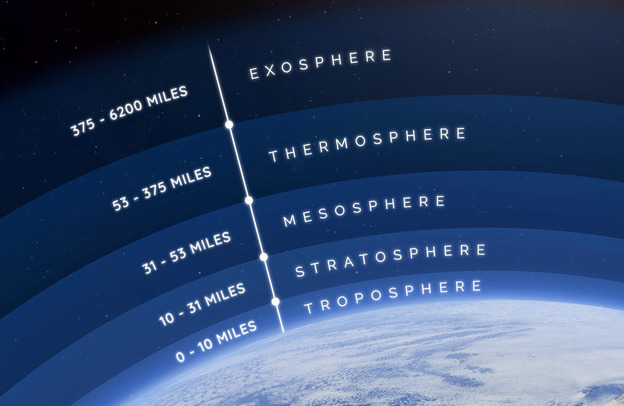
The exosphere is the outermost layer of the Earth's atmosphere.
Science Overview
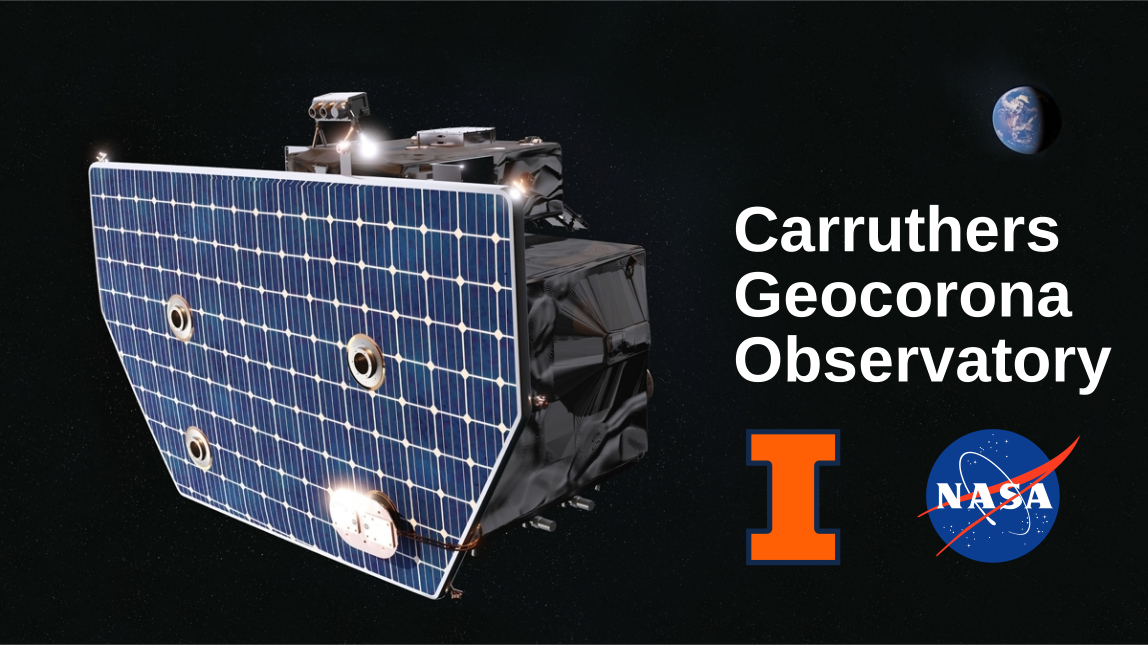
The Carruthers Geocorona Observatory is designed to investigate Earth's exosphere, the outermost region of the atmosphere where gas is so diffuse that particles rarely collide. The exosphere is primarily composed of hydrogen (H) atoms, which scatter sunlight and produce a vast halo of ultraviolet light known as the geocorona. Carruthers is equipped with two ultraviolet cameras to capture this geocoronal emission in unprecedented detail. These images will revolutionize our understanding of the nature and origin of exospheric structure and dynamics, particularly in response to transient geomagnetic storms.
Mission Overview
The Carruthers mission is a NASA Heliophysics Mission of Opportunity formerly known as GLIDE and renamed in 2022 after Dr. George R. Carruthers, a pioneer in space science and instrumentation. The Carruthers spacecraft launched on a SpaceX Falcon9 rocket from Kennedy Space Center as a rideshare with NASA's IMAP mission on September 24, 2025. After a three-month cruise phase, Carruthers entered into halo orbit around the Earth-Sun L1 Lagrange point in early 2026 and began routine science operations on March 1. L1 is a location in space, about four times farther from Earth than the Moon, where the gravitational forces of the Sun and Earth are balanced, allowing for a smaller object like a satellite to maintain a relatively stable position. From this distant vantage, Carruthers' two imagers have a dedicated, unobstructed view of Earth's exosphere and its far ultraviolet photon emission on global scales. The imaging target of Carruthers' scientific instruments is Earth's atomic hydrogen emission at 121.6 nm, a spectral line known as Lyman-a.
Carruthers' trajectory from launch to orbit around the L1 point, approximately 932,000 miles (1.5 million km) from Earth. From there, Carruthers' two ultraviolet cameras acquire nearly continuous images of Earth's vast exosphere. (Credit: NASA Scientific Visualization Studio, Tom Bridgman).
Payload Overview
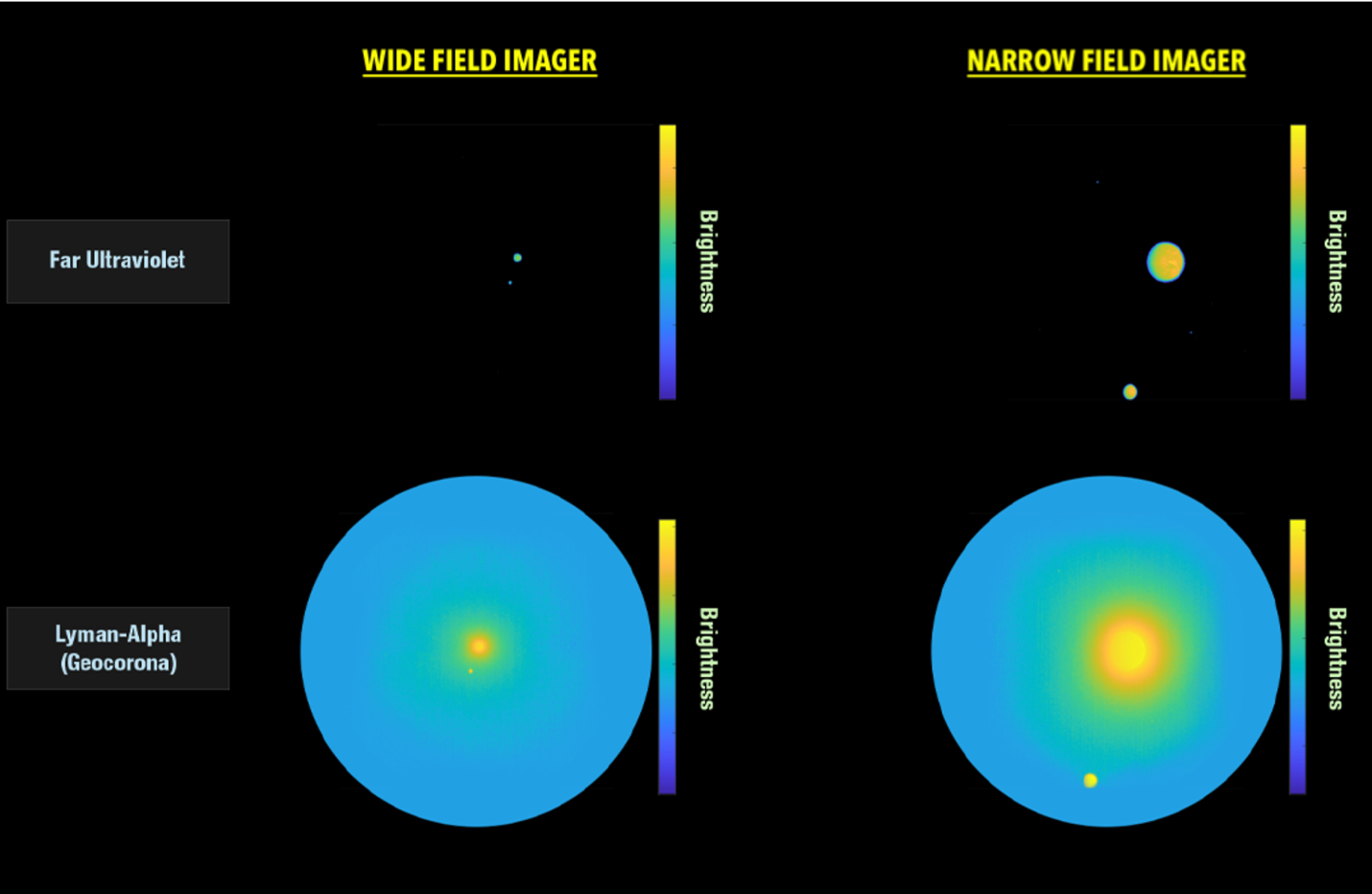
The primary scientific instrument onboard Carruthers is the GeoCoronal Imager (GCI), which is comprised of two co-aligned cameras: the Wide Field Imager (WFI) and the Narrow Field Imager (NFI). The NFI images the bright geocoronal emission from Earth's inner exosphere at high spatial and temporal resolution to detect small changes in exospheric structure in response to geomagnetic storms. The WFI captures the exosphere's entire global extent at lower resolution but at a sensitivity sufficient to detect dim geocoronal emission from its outer edges. Both NFI and WFI are equipped with a 6-position optical filter wheel that allows the cameras to target either geocoronal hydrogen Lyman-a emission line or the far ultraviolet light originating from Earth's lower atmosphere regions. A secondary scientific payload, developed primarily by students, is the Carruthers Student Solar Monitor (COSSMo), a set of ultraviolet photodiodes which measure the indicent solar photons that excite the geocoronal emission measured by the Carruthers GCI.
"First light" images for the Carruthers Geocorona Observatory mission. The images were taken on Nov. 17, 2025, from a location near the Sun-Earth Lagrange point 1 by the spacecraft's GeoCoronal Imager (Credit: NASA/Carruthers Geocorona Observatory)
Spacecraft Overview
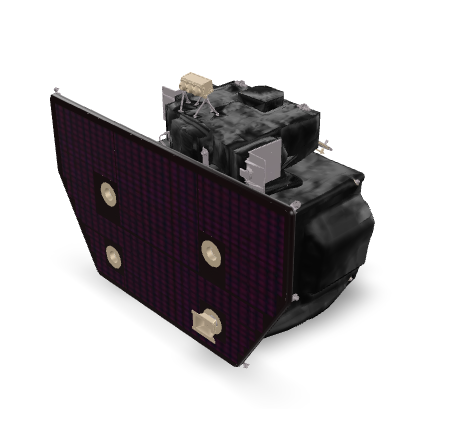
The Carruthers spacecraft weighs 531 pounds (214 kg) and is 67.8"W x 42.5'H x 38.1"D (about the size of a loveseat sofa). The GeoCoronal Imager (GCI) is mounted to the top deck of the spacecraft bus with its apertures oriented toward Earth, while COSSMo is mounted on top of the GCI, overlooking the fixed solar panels which face the sun and provide continuous power to the bus. Spacecraft command and data telemetry uses an S-band antenna to communicate with the NASA Deep Space Network at data rates up to 1 Mbit per second. Four thrusters provide propulsion for orbital maneuvers and stationkeeping, and Carruthers carries sufficient propulsion to maintain orbit around L1 for nearly a decade after its 2-year primary science phase.
Model showing Carruthers spacecraft instrumentation and bus. Banana for scale.
(Credit: NASA Conceptual Imaging Lab. Jonathan North)